Supply chain planning
Is Your Company Turning AI Into Better Supply Chain Results?
Explore strategies to manage your freight with AI amidst rising logistics costs.
Prepare for supply chain volatility as fuel prices fluctuate.
If this week proved anything, it is this: supply chain leaders cannot afford to mistake a price drop for a plan.
For days, the focus was on soaring fuel costs and the sharp rise in fuel surcharges. Then, almost overnight, news of a ceasefire involving Iran sent oil prices down by roughly 20%.
Some shippers may look at that drop and assume the pressure will ease.
That would be a mistake.
The real issue is not whether oil is up this week or down next week. The real issue is whether your company is prepared to operate in a market where conditions can change in a matter of hours.
That is the point that MIT professor Dr. Yossi Sheffi has been making: stop focusing on oil prices alone. The bigger risk is failing to plan for volatility.
And volatility is exactly what shippers are facing.
Just six weeks ago, on February 25, the average price of diesel was $3.71 and the average LTL fuel surcharge was approximately 27.82%. By April 6, diesel had climbed to $5.64, while fuel surcharges among some major LTL carriers had risen to approximately 51%. That is an increase of roughly 83% in a matter of weeks. Truckload surcharges have also risen sharply, increasing by approximately 60.5%.
Think about that.
When companies built their 2026 budgets, how many expected freight costs to move this far, this fast? More importantly, how many had already mapped out what they would do if they did?
That is why scenario planning matters.
Fuel is only one pressure point. Ocean markets remain unstable. Some shippers are seeing surcharges that rival the cost of moving the container itself. Delays, stranded vessels, and ongoing disruption continue to make inventory planning harder and more expensive.
And if those issues were not enough, uncertainty still surrounds IEEPA refunds for companies that paid duties under IEEPA. That is one more example of why shippers need more than awareness. They need a plan.
In this kind of environment, reacting is costly. Planning is essential.
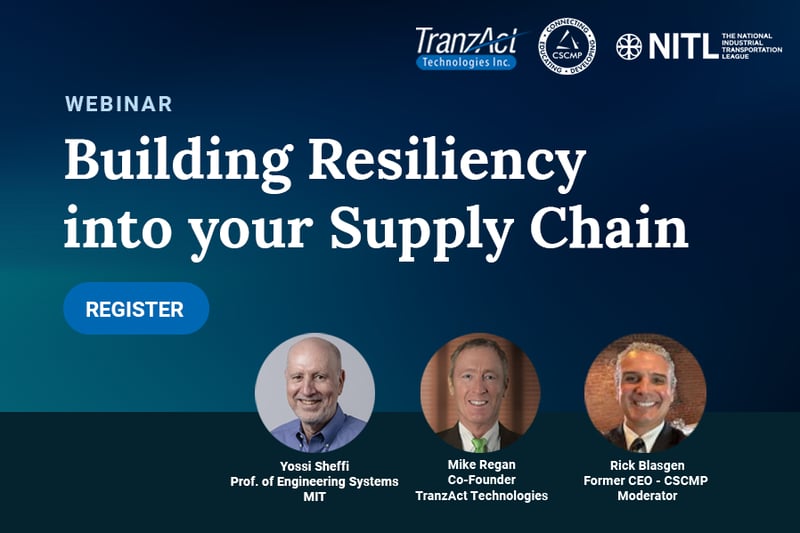
That is why we're hosting an upcoming webinar on this topic.
On April 22 at 11:00 a.m. CDT, TranzAct will join with the NIT League and CSCMP to host an important webinar featuring Dr. Yossi Sheffi, MIT Professor of Engineering Systems and Director of the Center for Transportation and Logistics.
Dr. Sheffi will join us to discuss the critical role scenario planning plays in building a more resilient supply chain and how shippers can prepare for a range of outcomes instead of betting on a single forecast.
Because if you do not have a plan in today’s environment, you are not managing risk. You are guessing. And in this market, guessing is expensive.
Register today and invite others on your team, because the companies that will navigate disruption best will not be the ones that guessed right, but the ones that planned.
Explore strategies to manage your freight with AI amidst rising logistics costs.
Prepare for rising logistics costs in 2027 by exploring strategies to manage your freight budget amidst fluctuating fuel prices.
Rising diesel prices are impacting logistics costs. Discover strategies to mitigate fuel surcharges and improve your freight spend management.
Subscribe for smart tips, market updates, and practical strategies to streamline operations, stay ahead of disruption, and boost savings.