Supply chain planning
Is Your Company Turning AI Into Better Supply Chain Results?
Explore strategies to manage your freight with AI amidst rising logistics costs.
Explore essential strategies for navigating the freight recovery, enhancing supply chain resilience, and managing costs effectively.
After nearly four years of soft demand, excess capacity, and relentless pressure on carrier profitability, it's becoming increasingly clear that the Great Freight Recession is over.
One critical point confirms this. When shippers start talking about becoming a "shipper of choice" again, things have changed.
For the past several years, carriers were fighting for freight. Capacity was plentiful, pricing pressure was intense, and shippers held most of the leverage. Heading into the remainder of 2026—and beyond—it looks like shippers may be fighting for capacity in parts of the truckload market.
Today, we're already seeing rates move higher and carriers shorten contract commitments from one or two years to as little as three to six months. Why? Because carriers believe their capacity will be worth significantly more six months from now than it is today. When carriers start shortening commitments, shippers should pay attention.
The question now isn't whether the market is changing. The question is whether shippers are prepared for what's coming next.
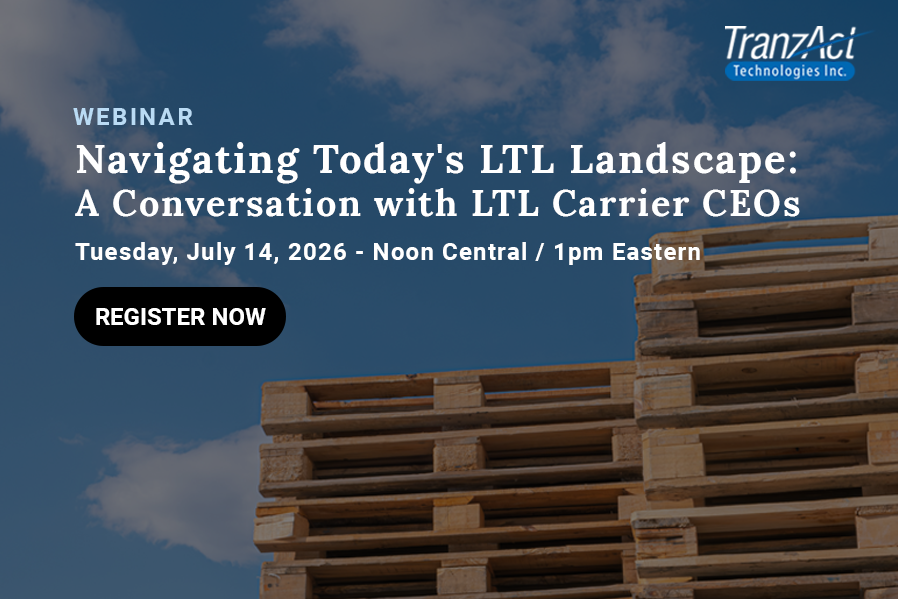
Switching to the LTL market, on July 14 we'll be hosting a special webcast with our partners at CSCMP and NITL featuring senior executives from some of the industry's leading LTL carriers. If you ship LTL freight—or simply want a better understanding of where the market is headed—this is a conversation you won't want to miss.
Practically speaking, the LTL market is changing as well. For years, many sourcing events were built around the assumption that all LTL carriers value freight similarly. They don't.
Some carriers aggressively pursue certain freight because it strengthens network density and improves profitability. Other carriers may have little interest in that same freight.
Understanding that difference can mean the difference between reducing transportation costs and leaving savings on the table. That's why understanding carrier behavior has become just as important as understanding your own freight.
At TranzAct, we're in the market every day conducting sourcing events, analyzing carrier responses, and monitoring how carriers position themselves in different markets and lanes. We understand what carriers are looking for, where they're trying to build density, and where they're willing to compete aggressively for freight.
That insight is the foundation of our proprietary Targeted Pricing methodology—a data-driven approach that helps us identify where your freight is most attractive in the market.
Throughout the sourcing process, we connect shippers with carrier partners in a way that drives stronger pricing, better service, and more sustainable transportation relationships.
The result isn't simply lower rates. It's a sourcing strategy built around how carriers actually make pricing decisions.
The carriers already know which freight strengthens their networks, improves density, and drives profitability. Most shippers don't.
That's a competitive disadvantage when negotiating with LTL carriers. Shippers that don't understand how carriers evaluate freight are negotiating from a position of weakness.
The companies that understand how carriers make decisions will be in a much stronger position to control transportation costs as the market continues to tighten.
If you're planning an LTL sourcing event, preparing for carrier negotiations, or simply trying to understand how these market changes may affect your transportation spend, don't go to market blind.
The carriers already know which freight they want.
The question is: Does your current sourcing strategy reflect that reality?
Before your next sourcing event, let's have a conversation. We'll show you how carriers are evaluating your freight, where your leverage exists, and where opportunities may be hiding in plain sight.
Give us a call at 630-833-0890.
Because matching the right freight with the right carriers has never mattered more.
Explore strategies to manage your freight with AI amidst rising logistics costs.
Prepare for rising logistics costs in 2027 by exploring strategies to manage your freight budget amidst fluctuating fuel prices.
Rising diesel prices are impacting logistics costs. Discover strategies to mitigate fuel surcharges and improve your freight spend management.
Subscribe for smart tips, market updates, and practical strategies to streamline operations, stay ahead of disruption, and boost savings.