Supply chain planning
Is Your Company Turning AI Into Better Supply Chain Results?
Explore strategies to manage your freight with AI amidst rising logistics costs.
Discover how rising diesel prices impact logistics costs.
Several months ago, when the conflict with Iran first escalated, we warned that it does not make sense to build a freight budget around a single version of the future. Some people told me we were crying wolf.
The wolf just showed up. Diesel crossed $6 a gallon last week - a new national record. The question now is not whether fuel is high. It is whether your freight budget was built to survive what comes next.
According to AAA, the national average for on-highway diesel reached $6.27 on Tuesday - up from $3.69 a year ago. That is a 70% increase in twelve months. The EIA index for the week of September 14 came in at $6.285 - a second consecutive weekly record. The Estes LTL fuel surcharge jumped 3.2 points in a single week to 56.9%. TL surcharges are now above 60%.
And the national average hides the real exposure. The West Coast is already above $7.25 a gallon. California has crossed $8.00. If your lanes run through those regions, your surcharge base is being calculated off those numbers - not the national headline.
The Invoice Math
The LTL invoice math
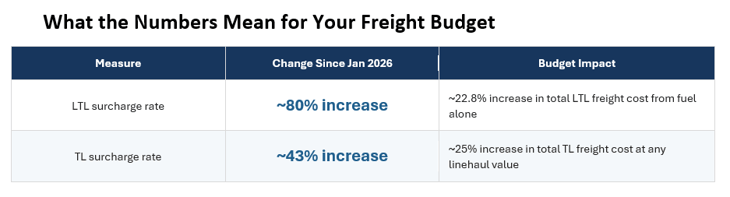
The LTL surcharge rate was approximately 28% of linehaul in December 2025. It is now running above 56% - an 80% increase in the rate itself. A $1,000 linehaul shipment that cost $1,278 in December now invoices at $1,569. That is a 22.8% increase on an identical move - same freight, same lane, same carrier. The only thing that changed is fuel. And at 56%, every $1.00 increase in your linehaul rate now costs you $1.57 on the invoice.
The TL invoice math
TL fuel surcharges have risen approximately 43% since January, moving from roughly 35% to above 60% this week. Here is the number that matters regardless of what your average truckload move costs - $400, $600, $800, or $1,000 - fuel surcharges have added 25% to that linehaul cost. Every dollar you budgeted for a truckload lane now carries an additional 25 cents in fuel surcharge.
Why This Will Not Snap Back Quickly
Take note: this is a refining shortage. That means planning for a sustained elevated-cost environment, not waiting for conditions to normalize.
The Planning Gap This Exposes
Too many companies still treat the freight budget as a prediction - one rate, one fuel assumption, one volume forecast. That approach works until the world does not cooperate. A freight budget needs to behave more like a range of possible outcomes. What happens if fuel rises while base rates increase simultaneously? What happens to margins by customer, product, and distribution point? Those are not just transportation questions. They are business strategy questions.
There is a major difference between being exposed to volatility and being unprepared for it. Recurring surprises are not just a market problem. At some point they become a planning gap inside the business.
Scenario Planning at CSCMP EDGE
October 4-6 | Mike Regan presents with Professor Yossi Sheffi of MIT on scenario planning - how companies prepare for disruption rather than react to it. Volatility is no longer the exception. It needs to be part of the plan.
Fuel Surcharge Executive Summary
Available to qualified shippers upon request
We have prepared a concise Executive Summary with specific, actionable steps your leadership team can take right now to reduce fuel surcharge exposure and protect margins. Here is a preview of what it covers:
1. Audit carrier contracts. Review fuel surcharge provisions, caps, and lag structures - and determine what to do when you find the gaps.
2. Use the five operational levers. Reduce fuel surcharge exposure without touching your negotiated rates.
3. Build multiple diesel scenarios. Model freight costs before your CFO asks.
4. Find consolidation and mode-shift opportunities. Calculate the ROI at today's surcharge levels, including options many shippers overlook.
5. Align the enterprise. Use scenario planning to bring transportation, procurement, finance, and operations together before the next disruption forces the conversation.
Request your complimentary Executive Summary | solutions@tranzact.com | 630-833-0890
We’re not recommending a crystal ball. Understand your exposure, identify what you can control, and act before the market narrows your options further.
If you are not confident your organization has done that work or want a second set of experienced eyes on where your real exposure sits, let’s have a conversation.
Mike Regan
Co-Founder and Chief of Relationship Development, TranzAct Technologies, Inc.
Let Us Uncover Insights Within Your Data
We will show you where your exposure sits, what your options are, and what a 15%+ improvement in freight spend performance could mean for your margins. No pitch deck. Just the work.
Here's how to get in touch:
☎️ Give us a call at 630-833-0890
✉️ Send us an email at solutions@tranzact.com
💻 Contact us by completing our online form
🕑 Schedule a conversation with a member of the TranzAct team
Explore strategies to manage your freight with AI amidst rising logistics costs.
Prepare for rising logistics costs in 2027 by exploring strategies to manage your freight budget amidst fluctuating fuel prices.
Rising diesel prices are impacting logistics costs. Discover strategies to mitigate fuel surcharges and improve your freight spend management.
Subscribe for smart tips, market updates, and practical strategies to streamline operations, stay ahead of disruption, and boost savings.