Supply chain planning
Is Your Company Turning AI Into Better Supply Chain Results?
Explore strategies to manage your freight with AI amidst rising logistics costs.
Learn key strategies from top LTL carriers that can enhance your freight management and reduce transportation costs.
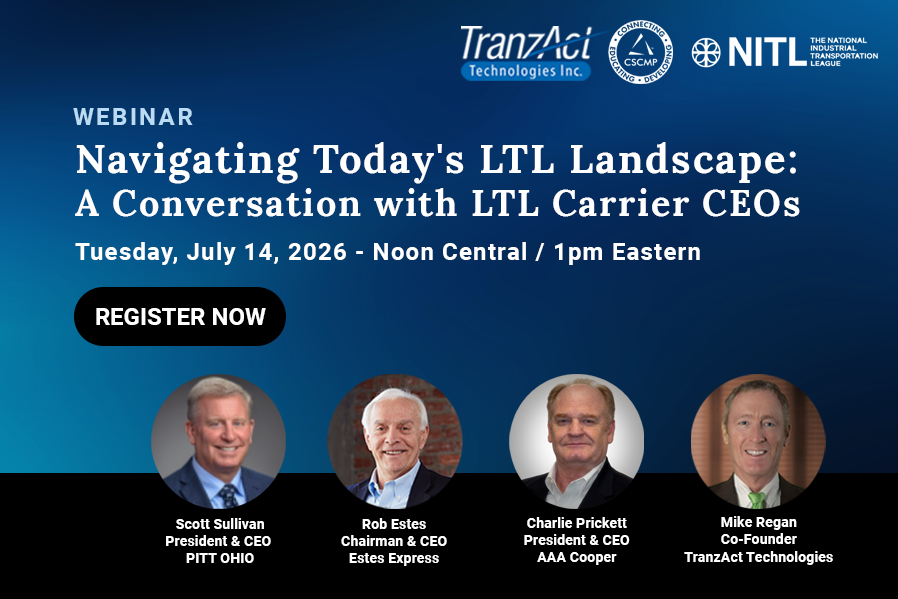
Next week, we're hosting a webcast with our friends at CSCMP and the National Industrial Transportation League featuring three executives from three of the top ten LTL carriers in the United States. Opportunities like this don't come along very often. When else do you get to hear directly from the leaders making decisions that shape the LTL market?
The webcast is Tuesday, July 14, at Noon Central. If LTL freight is important to your business, I encourage you to register for the webinar—and invite your colleagues as well. If you can't join us live, don't worry—we'll send the recording to everyone who registers.
Last week, I received a call from the CEO of a company who had received one of our invitations to the upcoming LTL webcast. He told me he'd heard from several executives in one of the leadership organizations I belong to about TranzAct's ability to consistently reduce transportation costs.
Interestingly, he wasn't calling to ask for another bid.
Instead, he said, "Before I ask my team to invest an hour, what will they learn that they don't already know?" He also wanted to understand why companies consistently achieve results with TranzAct that they haven't been able to achieve with other providers.
I told him the answer really comes down to three questions.
1. Do your carriers actually want your freight?
Most companies know their freight. Far fewer understand how well that freight fits within a carrier's network.
Those are two very different things.
Today's LTL carriers manage yield—not simply volume. They analyze shipment density, lane balance, terminal capacity, and network efficiency with remarkable precision. As capacity tightens, they're becoming increasingly selective about the freight they want to haul.
A carrier that's an excellent fit for your freight today may not be the right choice six months from now.
The companies that consistently outperform the market understand this dynamic. They align the right freight with the right carrier at the right time.
2. Do you understand your transportation costs from the carrier's perspective?
Most shippers understand their own costs. Far fewer understand the carrier's economics and the KPIs that drive pricing:
• Operating ratio
• Shipment density
• Cube utilization
• Terminal efficiency
These factors play a major role in how carriers price freight and determine which customers they want to retain.
One of the things that surprises executives during our sourcing engagements is how differently carriers evaluate their business than shippers do. Once you understand the carrier's economics, negotiations become much more productive—and frequently much more successful.
3. Are you paying for services your customers don't actually need?
Accessorial charges have become one of the fastest-growing components of LTL pricing.
Here's one example. A company analyzed its delivery requirements and discovered that only about 40 percent of its customers actually required liftgate service. Yet they had been paying liftgate charges on virtually every shipment.
That single assumption was costing them a substantial amount of money.
We encounter opportunities like this every day. Better shipment data. Better processes. Better visibility into carrier pricing. Small operational improvements often produce surprisingly significant savings.
The bigger issue is this: The rules have changed.
Today's LTL market is driven by sophisticated network optimization, operating economics, shipment analytics, and data. Companies that continue using yesterday's assumptions will find themselves at a competitive disadvantage.
Knowing the right questions is only the beginning.
Knowing how to answer them—and what actions to take—is where experience creates value.
For decades, TranzAct has analyzed carrier pricing, network changes, operating economics, and shipment data across thousands of sourcing engagements. That's why companies call us—not simply to negotiate rates, but to build transportation strategies that continue delivering value long after the sourcing event is complete.
Our Rapid Assessment replaces assumptions with facts. In a relatively short period of time, we can determine where opportunities exist, quantify their financial impact, and help organizations build a sourcing strategy based on today's market—not yesterday's.
For many companies, that has translated into transportation savings of 10 to 20 percent.
Whether you attend the webcast or not, ask yourself one question:
Are you confident you know enough about today's LTL market to achieve the best possible results?
If the answer is, "I'm not sure," let's have a conversation. For now, let's get you registered for our July 14 LTL webcast.
The LTL market continues to evolve at a rapid pace. In adapting companies can create a competitive advantage.
Information creates insight. Insight creates competitive advantage.
Explore strategies to manage your freight with AI amidst rising logistics costs.
Prepare for rising logistics costs in 2027 by exploring strategies to manage your freight budget amidst fluctuating fuel prices.
Rising diesel prices are impacting logistics costs. Discover strategies to mitigate fuel surcharges and improve your freight spend management.
Subscribe for smart tips, market updates, and practical strategies to streamline operations, stay ahead of disruption, and boost savings.